Sunday, January 13, 2008

Two Underwhelming Novels


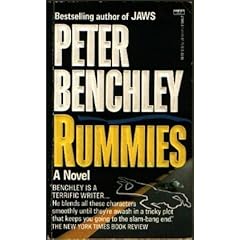
Getting the new year off in a distinctly underwhelming note are these two novels. No need for extensive commentary on the Koontz book; it's the same as other early Koontz novels. Written under a psydonym, full of stupid characters, and an unusually irritating plot/ending. Rummies by Peter Benchley was a book that I had higher hopes for, after having enjoyed Q Clearance, his previous novel. Unfortunately, the characters are largely stereotypes and the book lacks both the humor that it is supposed to generate and any kind of dramatic punch. It's a serious step backward for him. In other reading related news, I have agreed to participate in a book club through my work, so that should add some much needed novelty into my reading choices over the next few months.

Thursday, January 10, 2008

Year in Review

2007 was the first year I have successfully kept a reading log for the entire year, and I'm sure my public would be anxious to know the totals. Well, this isn't the Oscars, so I'll skip straight to the final catergory: 21,944 pages read. I feel like that's not bad, though, of course, I have no previous numbers to compare it to. It is at least close to the most I've read in a year, though I can't be sure. A further breakdown:

54 total books read, plus Ruth through Galatians in the Protestant Bible
14 books by Stephen King
9 Left Behind novels
12 Dean Koontz books
4 Peter Benchley novels
6 Aldous Huxley books
2 Fyodor Dostoevsky books (one short novel and one collection)
1 Jack Kerouac novel
and a smattering of other stuff

I am starting 2008 by continuing with these authors, with the exception of Left Behind, which I have thankfully left behind. I hope to at least double the amount of authors I am reading, as well as possibly finish up Benchley this year. And, of course, I hope to have a bigger total in 2008 than 2007.

Monday, December 31, 2007

Out Come the Wolves


The fifth of seven books in Stephen King's Dark Tower series, Wolves of the Calla, is not dissimilar to the fourth book in that it does not move the ka-tet much closer to the conclusion of their journey by the book's end. However, the story it tells is compelling and I was rarely irritated in the course of this long novel. The plot has our travelers stopping in a small community to help them fight a mysterious bunch of marauders that sweep into their hamlet every twenty odd years and steal half the children--these invaders are the literal wolves of the title. We also are reminded of some of the less savory aspects of the characters that are the heroes of this series, and have to recognize that, in their own way, they too are wolves.

King paints a convincing landscape and makes good use of a local dialect to help establish a sense of place. Also, I found having previously read 'Salem's Lot was an advantage in this book, as a character from that novel makes a return appearance. I am told that other characters from other King works also find their way back into this series, but since I haven't read him exhaustively, I can't say for sure. I can understand on one level why Tower fans might be disappointed with this entry, as it is essentially another pit stop (or even a stalling maneuver), but why argue with it when it's perfectly enjoyable? The Tower will be here soon enough.

Sunday, December 16, 2007

Remarkable

Kerouac's first novel is a remarkable read. It is expansive and insightful, full of character and memorable moments and writing. It is quite different from On the Road, less pulsingly energetic, but with a lot of pathos and integrity. It simply gets better and better the further you read, and by the end Kerouac seems to have really found his voice. There isn't a lot of plot to speak of, but by the time you've finished you have a full picture of a family in all its blooming glory and grieving.

While I haven't done a comprehensive review, I think I'm safe saying that I haven't read a better book this year. I'm looking forward to reading more Kerouac in 2008; he is among the most distinctive and important writers in the American tradition.

Sunday, November 25, 2007

The Eyes of Dumbness


The Eyes of Darkness is much like other recently reviewed Dean Koontz novels--an unmitigated bomb. I know it's a cliche to say that you are rooting for the bad guys in a bad movie or book, but, man, I was really rooting for the bad guys. The Koontz formula has worn completely thin, and I feel nothing but revulsion for his characters. There is a character named Eliot Stryker in this book.

One quick point about the plot: it revolves around a child being held in a government detention center that has amazing psychic and telekinetic powers. He can move thousands of pounds with his mind, make guns not work, and communicate over thousands of miles. And he needs his mom to come and rescue him from the armed guards that keep an eye on him. The whole book is moot because he could obviously just leave any time he wanted. God I hated this book.

Friday, November 23, 2007

And the Tower is Closer


The Dark Tower series continues moving forward with a very different fourth volume, Wizard and Glass. I was somewhat put off by the telling of this story; almost this entire book is a flashback to Roland's youth. Though the Tower is closer, it's not much closer by the time this one is over. I understand the compulsion to fill out some of Roland's backstory, but I wonder if knowing this level of detail is truly necessary and useful. I think it has worked to the series advantage to have Roland be mysterious and unfathomable--he is after all from a world that is very different from Earth, and it makes sense that he would be emotionally alien.
To a lesser extent, I was annoyed that the book is so filled with 'thou' and 'ye' and 'aye'. Supposedly this represents part of dialect that is commonly used out in the hinterlands where the action takes place, but it just brought to mind bad period fiction to me. Still, if you've read this far, you're committed to the series, and I don't want to make it sound like I hated Wizard and Glass. There is plenty to enjoy, and it's strengths are some of the same as earlier volumes in the series. But I hope we can put this episode behind us now, and that King will move toward the climax without more tangential stories.

Saturday, November 17, 2007

Dostoevsky Redux


I read Notes from the Underground when I was in high school and it was a real touchstone for me. It spoke to me directly, and recognized the peculiar pleasure we take in misery in a truthful way. I would still put it on the shortlist of novels that are essential reading. So for a long time I've been meaning to work back around to Dostoevsky's other works, particularly the long books that he is known for. And I'm happy to report that I am finally doing that. Of course, the book I'm talking about here is not one of his more famous long books, though it is a rewarding and fascinating read. Dostoevsky's characters, even in these shorter works (in a relative sense; these are closer to novellas than short stories) have a wonderful sense of urgency and are driven toward their inexplicable but emphatic actions by feelings over which they have no mastery, and often very little comprehension. The Double and White Nights are highlights, but there really are no low-lights in this volume. Dostoevsky's literature is probably the most cogent argument for conservatism around, emphasizing that people often intentionally act against their own interests and that reason holds little sway. In a world populated with these characters, it is impossible to see an enlightened society develop. But Dosoevsky also has a sly sense of humor and absurdity, and it's not uncommon to find yourself smiling as you read.
Reading the classic Russian writers always makes me think of dark spicy beer or strong black coffee. It's thick and should be consumed slowly and is best in the winter. Not something you'd enjoy on the beach, but at the right time, deeply satisfying.